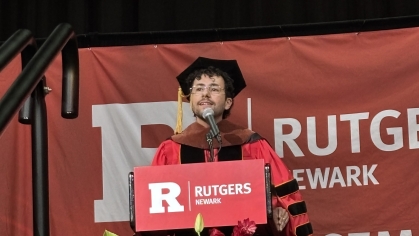
As a child of the 1980s crack epidemic, Miseka Diggs was one of many who found a way to survive as families around her – including her own – were torn apart by addiction. At the age of 11, she sold drugs.
Her story isn’t unusual, said Diggs, who will graduate from Rutgers-Newark this week at the age of 49 with a bachelor’s degree in Social Work.
“You had a community that’s left behind. Kids as young as me had to fend for themselves,’’ she said. “You may not have food, clean clothing, and maybe not a roof over your head. Because of this many of the youth from my time gravitated to selling drugs. Basic survival tactics. This was getting basic needs met."
Like Diggs, they had no support. Few adults outside their neighborhoods – first New Brunswick and, later, Newark – understood what they were going through or offered help. In 6th grade, she stopped showing up at school. “Nobody came looking for me,’’ she said. “No truancy officer. Nobody.’’
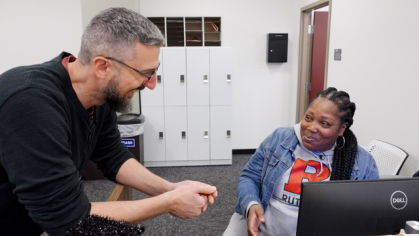
At 16, Diggs became a mother. At 18, she received her first sentence for dealing drugs, the start of a long downward spiral that continued through adulthood.
That changed after she received her GED. Thirty years later, she enrolled in Rutgers University’s NJ-STEP program, which enables incarcerated men and women to earn degrees.“I signed up for college classes and found my new love. I found my new everything: Education. I think it may have been so powerful for me because I didn’t really have it as a kid. I just gravitated to it,’’ said Diggs.
After commencement, she plans to earn her master’s in Social Work at Rutgers-Newark. Her goal is to help women with pasts like her own re-enter the world after incarceration. “I am that woman. I understand what she needs. I know what resources are lacking,’’ she said. “Nobody is going to save our communities but us.”
It’s work that she began in prison, where she established herself as an advocate for fellow prisoners at Edna Mahon Correctional Center. She began speaking out during the COVID-19 pandemic, alerting others to the lack of medical care in the facility, where there were few if any efforts to curb the spread of illness.“I was the voice of the people behind the wall,’’ she said. “Just seeing what we had to go through. It was a no-brainer that I became an advocate. It was in my blood.’’
“Even before her release, she was already gaining national media attention for pushing for safer spaces and equitable opportunities for incarcerated women,’’ said Chris Agans, Executive Director of NJ-STEP. “She understands the challenges women and returning citizens face, and she’s already proven she knows how to turn that understanding into action.’’
After leaving prison, Diggs was accepted into Rutgers-Newark’s Honors Living-Learning Community (HLLC), which cultivates the leadership skills of high-achieving local students of all ages, in addition to those from all over the U.S.
“Miseka was selected because she embodied the very qualities our program seeks to cultivate: resilience, purpose, and a deep commitment to social justice,” said Engelbert Santana, HLLC Dean of Advisement. “From the moment we read her application, it was clear that she possessed a powerful voice shaped by lived experience and a genuine desire to create change for others.’’
“She embraces her accomplishments, not because of the accolades themselves, but because she understands what those moments represent for others who see themselves in her story,’’ he added. “Her advocacy has expanded to even greater levels, and she now moves with a sense of purpose and responsibility that inspires everyone around her.’’
Diggs’ endurance, and her insight into how to support others, grew from an almost unbearable amount of pain and loss that began at age 8, when her older sister was murdered.
After that, Diggs’ mother, who had once been passionate about politics and activism, became an addict. As a child, Diggs also suffered sexual abuse and at age 10, was sent to the New Jersey Training School, a juvenile correctional center in Skillman, which closed by the state in 2018 following investigations that identified systemic abuse and high rates of sexual assault.
Her year at Skillman began after she threw a bottle at a police officer in an attempt to intervene during an altercation between the officer and her brother. “By this time I was already angry,’’ she said. “I was building up this wall of anger.”
Diggs received no counseling or support, and no sympathy from the judge who sent her to Skillman. “He said, ‘she won’t see daylight until the cows come home,’’’ Diggs recalled.
After serving her first prison sentence, Diggs worked her way up to a manager’s position at Panera but resorted to selling drugs again to support her 85-year-old grandmother, one of the few sources of stability and encouragement in her life, who was no longer able to care for herself and didn’t qualify for assistance because her income level was $44 above the threshold.
“I went back to what I thought I knew,’’ she said. “Everything I tried to avoid happened anyway. She wound up going to a nursing home because I got locked up.”
Today, she realizes how she contributed to the destructive dynamic of supply and demand in her neighborhood, even though at the time, she believed she had no choice.
“Now I know that selling drugs just caused more pain in the lives of people from my community. Now, I understand that this was breaking my community. I understand the cycle. Now I understand I have to be part of the solution,’’ she said.
But she also recognizes that larger social and economic forces destabilized communities like her own and hopes her work can contribute to policies that will improve the lives of others. “I want to challenge theories in place about communities that look like mine,’’ she said.
The support she gained at Rutgers-Newark has been invaluable and it’s one reason why she will be attending graduate school at RU-N, even though some Ivy League schools were an option for her.
“I gained a family of people who want to see me win. I gained a sense of belonging and I gained a lot of love and guidance and a lot of knowledge,’’ she said. “They believed in me when no one else did. I’m staying right here at Rutgers.’’
For now, Diggs has a student job at Newark Public Safety Collaborative, a School of Criminal Justice program that works with Newark residents on crime prevention measures, and a summer job with Communities in Cooperation (CIC), a nonprofit that partners with Rutgers on programs focused on adult reentry, and youth development.
She is helping young women realize their own dreams and potential. “I’m mentoring them. Two want to be traveling nurses. One wants to go to business school, another wants to study sociology.’’
Diggs is devoted to supporting them and leading by example.
“I’m truly grateful for the opportunity to work through that type of pain and trauma that kept me in its grip for so long. I’m grateful that my higher power saw fit to choose me and walk me through this,’’ she said. “I’m going to come home with a degree and maybe I can change some lives.’’