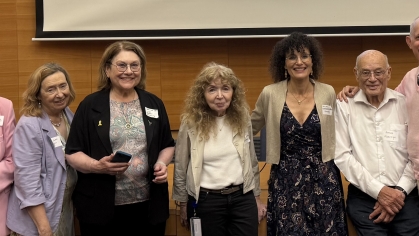
'Lighting Talks’ Present Innovative Research at Rutgers-Newark

The range and quality of Rutgers University–Newark research was showcased at a “lightning talks” event, where nearly a dozen researchers had four minutes to describe their discoveries.
The presentations, which included all of the Chancellor’s Seed Grants projects, ranged from research on early detection of Alzheimer's disease to the use of soil to mitigate pollution in Newark. “This is our first lightening talks event and shows the extraordinary breadth of research, scholarship and creative activity at Rutgers-Newark,’’ said Joel Caplan, senior vice chancellor for research and collaborations.
Hosted by the Office of Research and Sponsored Programs, the event gave faculty, students, and postdoctoral researchers a chance to briefly explain their work.
Chancellor Tonya Smith-Jackson described how researchers at Rutgers–Newark have impacted surrounding communities and beyond. A priority for Rutgers-Newark is to move from an R2 institution, which designates high research activity, to an R1, the highest classification for research activity.
The lightning talks’ presentations reflect a goal of the university wide Rutgers EDGE plan, which includes increasing sponsored research, and expanding seed funding and research development. Seed grants fund early-stage work so researchers can produce the initial results needed to compete for larger external grants.
“We’re not just knowledge consumers, we’re in the game of creation, helping the world understand things better but doing it from a human lens,” she said. “It’s not just about knowledge creation. It’s purpose-driven, mission-driven activity.”
The talks closed with reflections from undergraduate student Yashica Sharma, a biology major and aspiring pediatric neurosurgeon, who described how participating in research has inspired her career path.
“In every lab, I had to take something complicated and figure out what I couldn't yet explain,” she said. “That has changed what I want for medicine. I want to become a pediatric neurosurgeon, and I'm drawn to a field where what we observe clinically is often only the beginning of the story.”
A roundup of the projects presented showed how Rutgers–Newark researchers are working across disciplines to improve lives and achieve scientific breakthroughs:
• Postdoctoral researcher Katherine Rodriguez of the Department of Earth and Environmental Sciences presented work centered in the North Ward of Newark, an area exposed to emissions from heavy truck traffic and other pollutants. Collaborating with an urban farm, Rodriguez studied the effects of adding biochar compost to soil in an effort to potentially improve soil and air quality.
• Psychology professor Vanessa LoBue described plans for a Science Bus, a mobile lab and classroom that would make stops in Newark neighborhoods, expanding residents’ knowledge and collecting data.
• Postdoctoral researcher Bernadette Fausto of the Center for Behavioral and Molecular Neuroscience presented her efforts to develop a noninvasive method of early Alzheimer’s detection that is “age agnostic.”
• School of Public Affairs and Administration professor Jin Ai gave an overview of research on AI-created social media ads used to increase nonprofit donations.
• Disability studies professor Lauren Shallish gave a talk called “The Future Is Disabled” about the history of eugenics in New Jersey and academia and the importance of equal rights for those with disabilities.
• Political science professor Janice Gallagher presented research on the rising number of immigrant detainees who advocates say are intentionally lost in the DHS system after being detained, comparing their treatment to similar cases in Latin America.
• Physics professor Michele Pavanello outlined research that could help improve the safety and effectiveness of batteries, including those that charge cars and are involved in solar and wind power.
• Postdoctoral researcher Cory McCabe of the Department of Psychology presented research on reading comprehension among those on the autism spectrum.
• Chemistry professor Elena Galoppini presented her research on chemical reactions that could play a part in efficient energy technologies and have pharmaceutical and biological applications.
• Arts, Culture and Media professor Alexandra Chang presented a research project centered on global performances involving human-computer relations.