Marion Thompson Wright Series Looks Back at Ancient Africa and Imagines the Future
Like many schoolchildren, Lacey Hunter was taught that ancient history began in Mesopotamia and ended with the fall of Rome. There were no lessons about the ancient history of Africa.
“It’s a glaring omission. We get stuck in this loop of thinking of African people as perpetually enslaved and existing outside of any history before that,’’ said Hunter, Associate Director of the Clement Price Institute on Race, Ethnicity and the Modern Experience.
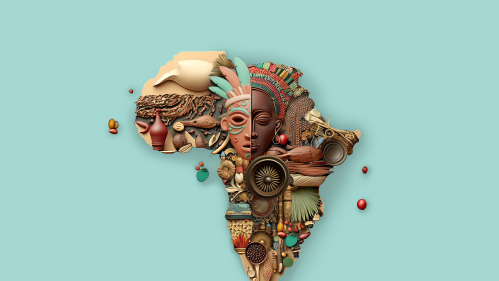
Because so much about early African civilizations isn’t widely known, the institute will take a closer look with Beyond Time: Ancient Africa, History and the Black Imagination.’That’s the title of the 46th Annual Marion Thompson Wright Lecture Series. The day-long event on February 21 starts at 9:30 AM and will be held at the Paul Robeson Campus Center. Register here to attend the event, which is free.
The event, which is hosted by the Price Institute, will explore how ancient African societies, which have long been viewed from a European perspective, can continue to shape imagination, creativity, and visions of the future.
“Ancient history can be daunting. It feels far away from what we’re living right now, but it isn’t,” said Hunter. “We’re hoping to go back to a much earlier moment in human history and give people space to think about our shared past.”
The first human beings – homo sapiens – originated in Africa more than 300,000 years ago, so the continent’s past belongs to everyone, Hunter explained.
“This series allows us to think about the beginning of us all,” she said. “In a way we are all African people. To erase our history is to undermine all human history.”
The event features presentations by three internationally acclaimed scholars and artists, including acclaimed author Nnedi Okorafor, whose graphic novels Black Panther: Long Live the King and Wakanda Forever were the foundation for Marvel’s blockbuster Black Panther films.
Okorafor’s work, including the Binti Triology—now in development as a series with HBO—draws directly from ancient African mythologies and cosmologies to imagine the future.
“It’s this really cool way of thinking about how these ancient histories are moved forward so that they help us think about the relevance of antiquity in our present time,’’ Hunter said. “A lot of what we know or can know comes through imagination. There haven’t been a lot of books that allow us to think about what was there prior to one moment in colonial history.’’
Also speaking at the event will be Nwando Achebe, a leading scholar of West African women’s histories and daughter of legendary Nigerian author Chinua Achebe. Nwando Achebe’s work challenges assumptions about gender roles by documenting societies in which women held social, political, and economic power prior to European intervention.
“Her research offers us a sense of the kind of gender balance that was there before European arrivals and the transatlantic slave trade,” said Hunter.
The final speaker of the series, Esailama Artry Diouf, an international performing artist and scholar of West African and diasporic dance histories.
“We think that everything has to be on paper to be official, but intangible things—our folklore— tells the histories of communities and societies. Physical movement can be part of celebration or mourning. It often carries narrative through generations,” said Hunter.
Since 1981, the Marion Thompson Wright Lecture Series at Rutgers University–Newark has invited the public to engage with history in ways that expand how the past is understood.
It’s named for East Orange native Marion Thompson Wright, whose doctoral thesis, The Education of the Negro, documented illegal school segregation in New Jersey and helped provide the NAACP with critical data for Brown v. Board of Education, the Supreme Court case that ended school segregation in 1954.
The lecture series, committed to bringing scholarship to a general audience, remains a cornerstone of Newark’s civic, cultural, and creative life and has its own traditions.
Each year, there is a performance of “Lift Every Voice and Sing,’’ known as the Black national anthem, by percussionist Jerome Jennings, who draws upon the annual theme to reinterpret the song.
After the lecture series, guests are invited to a reception at the Newark Museum of Art for our reception, where the Bradford Hayes Quartet will perform live.
“We really want folks to come,” said Hunter. “Don’t feel daunted by the word ‘ancient.’ Folks can expect to have a good experience, as always.”


