Rutgers Professor Traces the Resurgence of NYC's Washington Heights
Rutgers University–Newark historian Robert Snyder has a deep connection to Washington Heights, the neighborhood near the northern tip of Manhattan between 155th and 190th Streets.
He was born in 1955 and lived the first year of his life there. And though his parents moved the family to the New Jersey suburbs in 1956, Snyder grew up on stories of his old neighborhood, a place they described affectionately as great for working people, rich with urban amenities. As a teenager in the 1960s and ’70s, he took occasional walks through the western section of Washington Heights, convinced it was still a happy place.
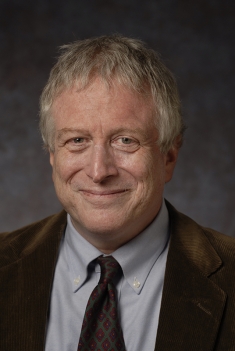
But in 1980, he returned to do an oral history project, only to find a different story: residents fearful of crime and ill at ease with their Spanish-speaking neighbors. In 1983, an elderly woman was murdered 10 blocks from his parents’ old house. Three years later, U.S. Attorney Rudolph Giuliani and U.S. Senator Alfonse D’Amato ventured into the neighborhood, in disguise, to demonstrate the ease of buying crack cocaine there. In 1989, Snyder went back to study how crime reporting depicted his old neighborhood, going on police patrols in drug-infested areas donning a bullet-proof vest.
Snyder wondered where his parents’ idyllic neighborhood had gone.
“I’d hoped to write a book about Washington Height for many years but didn’t want to write a story about my parents’ old home with a sad ending,” says Snyder. “It was hard to see a bright future for the neighborhood.”
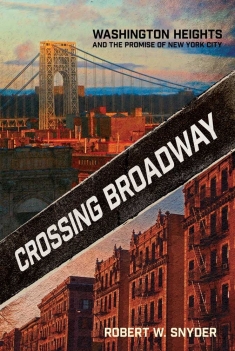
Starting in the mid-’90s, however, the area started gradually to turn around through the hard work of activists, business leaders, religious and cultural organizations, elected officials and others—and Snyder finally wrote his book: Crossing Broadway: Washington Heights and the Promise of New York City, published recently by Cornell University Press.
The neighborhood’s near-miraculous recovery, made possible through the commitment of those invested in the area, is captured by the geographic reference in the book’s title: “Crossing Broadway.”
“The different ethnic groups in the neighborhood had to overcome their tribal instincts and work together to overcome enormous problems,” says Snyder. “My book examines the heroes who literally and figuratively ‘crossed Broadway’—the geographical dividing line between the affluent and poor, white and black, Dominican and America-born—to rescue Washington Heights and start its current resurgence.”
It didn’t come easily, according to Snyder.
The fiscal crisis of the ’70s, growing racial tension and crime, and the crack epidemic of the ’80s and early ’90s had taken their toll. Getting residents to look beyond their parochial interests and venture out of their socio-linguistic enclaves was challenging enough. It was all the more difficult amid rampant crime, dilapidated housing, poor public schools, and parks too dangerous to step foot in.
“Concerned residents who wanted to take back their neighborhood ended up turning the very things that had hindered them before—the area’s population density and diversity—into an asset,” says Snyder. “They looked around and found allies in the neighborhood and in City Hall. That’s what drove this recovery.”
Capitalizing on those elements required a certain mindset, however, one with roots in the New Deal. And the book’s narrative is framed in time accordingly: from the New Deal to the present. As Snyder tells it, the activists who forged alliances and found common purpose among the various religious and ethnic groups fought for a richer, more inclusive vision of urban life, one in which the neighborhood and city were to be shared by all its citizens.
While weaving this tale, Snyder manages to deftly connect Washington Heights’ problems with larger structural issues facing the nation during this timespan, such as racial and economic inequality, federal urban policy of the ’70s, the shift from an industrial to a service economy, along with the rising gap between rich and poor in the age of globalization.
He says that given the size of the problems they faced, the individuals and groups involved—as effective as they were—nevertheless needed city, state and national resources to dig the neighborhood out of crisis and make progress.
The same can be said for longtime residents today as they deal with the irony of their success: gentrification and soaring rents, plus a growing artistic and literary scene.
“The people who worked to save the neighborhood deserve more than a stiff rent increase,” says Snyder. “Income and economic inequality, combined with a spike in rents, are the real problems now. We’ll need larger city, state and national efforts to combat them.”


