On Thursday, June 23, 2016, the United Kingdom (UK) voted to leave the European Union (EU) in a decision that launched global uncertainty with stock market fluctuations, political instability, and possible division within the United Kingdom itself. The decision to leave the EU (known as the “Brexit” vote) has cast a spotlight on the United Kingdom as countries throughout the world speculate as to how they will be affected by the UK’s choice, and what lies ahead for the UK.
Mere weeks before the UK’s affairs took center stage, several SPAA graduate students traveled to its capital, London, to gain firsthand insight into the city’s political and cultural climate. The trip was the highlight of an inaugural class titled “How London Works” taught by Dr. Lawrence Goldman.
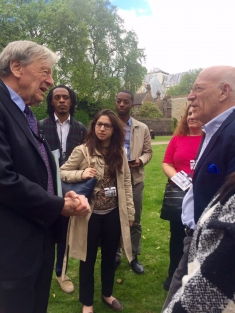
Goldman said that the trip had three themes: examine the Brexit debate; establish a general understanding of how London functions politically, socially, and economically; and explore how investment in cultural institutions can transform cities. Focusing primarily on the Brexit vote, Goldman’s class met with various speakers, including Alf Dubs, a member of Parliament’s House of Lords, who enhanced the students’ understanding of the European Union.
“Not only did [Dubs] take us on a wonderfully interesting insiders’ tour of Parliament… but he also arranged for other speakers who debated for our ten Rutgers students on both sides of the issue,” Goldman said.
During their trip abroad, the students were also treated to tours at London’s premier arts centers, the Southbank Centre and the Barbican Centre, in addition to interviews with the centers’ CEOs. They watched a performance at the Barbican Centre, and had the opportunity to enjoy the city’s restaurants and attractions, such as the London Eye.
“I really liked the ‘below the surface’ access that we got to London culture,” said MPA student Aisha Irvis. “It was really eye-opening, and I think as Americans we don’t really appreciate how much World War II still affects the UK to this day. The EU came together as a way to prevent those countries from trying to kill each other again, and many of the speakers brought up WWII and how it has shaped policy…”
Irvis stated that she was pleasantly surprised by how independent the students were required to be – arranging their own travel, lodging, and transportation throughout London – which gave her a sense of accomplishment.
The divisive political atmosphere in London and the rest of the UK over the Brexit decision allowed students to draw parallels between UK politics and the contentious presidential election in the United States. Students observed that many of the ideological conflicts here and abroad centered on issues of race, immigration, and national identity.
Goldman required the students to demonstrate their grasp of foreign affairs through presentations as well as research papers advising a hypothetical editorial board on which position to support in the Brexit debate (the class overwhelmingly supported a decision by the UK to remain).Irvis, who currently works as a development associate at the New Jersey Performing Arts Center, said that participating in Goldman’s class ignited her love for international affairs, which she hopes to incorporate into future employment opportunities.
According to Goldman, students have called the experience “life-changing,” with some choosing to prolong their stays in London, and one seeking opportunities that would allow him to live and work in the city after graduation.
“My theme in my courses and in this London study group has been ‘how do public decisions and public policy really get made?’ and I try to steer the group to the practical side,” Goldman said.
Top photo: Rutgers SPAA students on the London Eye during their study abroad course in London in May 2016.
Left photo: Rutgers SPAA students talk with Lord Alfred Dubs, member of the House of Lords.