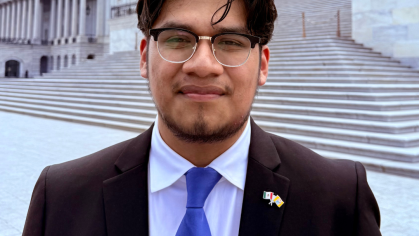
Inspired by Mother’s Struggles, Student Wins Obama Voyager Scholarship to Study Prison Reform

Pricilla Jimenez knows how devastating incarceration can be. She saw what it did to her mother, who never received proper treatment for substance abuse and, as a result, was unable to stay out of prison for long.
“My mother’s case gets me really upset because I don’t think she had much of a chance. If she had more support or care, maybe things would have been different,’’ said Jimenez, a third-year student and political science and English major. “She is a product of the inhumanity of the prison system.’’
As a recipient of an Obama-Chesky Voyager Scholarship for Public Service, one of the nation’s most competitive awards in her field, Jimenez plans to explore how things could have been different. She hopes to travel to Norway, where the prison system is internationally regarded for its focus on rehabilitation and education, not punishment.
The scholarship program, created by the Obama Foundation and Airbnb co-founder Brian Chesky, provides financial support, leadership development, and funding for a self-designed summer voyage focused on public service.
Jimenez plans to use the opportunity to travel to Norway and study a prison system that has gained international attention for emphasizing rehabilitation, education and reintegration rather than punishment.
Growing up, Jimenez struggled to understand why her mother repeatedly entered and exited the criminal justice system.
“Comprehending this at a young age was very difficult,” said Jimenez, a student in the Honors College.
Through courses at Rutgers–Newark and internships in the New Jersey courts as well as U.S. Congressman Rob Menendez’s office, she learned how incarceration in America evolved and how it has been shaped by policy. She discovered the problem was bigger than her mother’s addiction, which she believes was exacerbated by a harsh system with few resources to help her.
“I started to learn more about political science and the kind of systems she was cycling in and out of,” Jimenez said. “It wasn’t her that was really the issue.”
At a summer program at the Stanford Law Scholars Institute, Jimenez learned about the school-to-prison pipeline and disparities in the criminal justice system.
“It was created to leave people out,’’ she said.
She also met students from families like her own, which caused her to reflect on the hardships her mother faced from a young age. Her mom became a teenage mother at 17, without much help available to her.
“She wasn’t always a drug addict. She had potential,’’ said Jimenez.
During a criminal justice course, Jimenez learned about Norway's prison system, which emphasizes education, mental health services, vocational training and reintegration.
“Why aren’t all prisons like that?” she wondered.
She is particularly interested in how Norway begins supporting incarcerated individuals immediately and treats them as people capable of growth.
“There are people who have psychiatric illnesses,” Jimenez said. “For people who have a chance at re-entry and a good life, they deserve to be treated like a human from the very beginning, and using that time to grow really helps.’’
In Norway, prisoners live in environments that are more akin to college dorms. They have access to TV and games. Unlike prisoners in America, they’re allowed to use knives and forks, said Jimenez.
“The U.S. treats prisoners like animals,’’ she said. “In Norway, they don’t feel they need to go back to the life they led before because they’re treated humanely and supported. The recidivism rate is crazy low.”
During her Summer Voyage, Jimenez hopes to visit correctional facilities, meet researchers and correctional leaders, and better understand how Norway's approach contributes to lower rates of reoffending.
She also plans to investigate the policy barriers that prevent broader adoption of evidence-based reforms.
Her passion for improving the criminal justice system also fueled a growing interest in public service and law. Since arriving at Rutgers–Newark, Jimenez has pursued opportunities that deepened her understanding of law, government and public policy.
She completed an internship with New Jersey's Department of Children and Families, where she learned about cases involving abuse, sexual assault and discrimination. She later worked in the district office of Congressman Rob Menendez, helping constituents navigate federal programs and benefits.
“I learned that representation in and of itself, no matter how big or small, can give an entire struggling community hope,” she wrote in her application essay. “No matter the issue, I learned the importance of listening to individual stories and giving each a chance to be truly heard.’’
After returning from Europe, she hopes to continue researching prison reform, potentially working with scholars affiliated with Stanford's Three Strikes Project and organizations such as the Brennan Center, the Innocence Project and the ACLU.
Although she still plans to attend law school, her experiences have broadened her understanding of opportunities in the field of law.
After working in courts and government offices, she realized that meaningful change is possible through many pathways.
“I don’t have to be a lawyer to do all the things I want to do,” she said. “I want my career to reflect a commitment to justice and service.’’